

Renting your staff from an outsourcing agency is a tax on your firm's growth that you can no longer afford to pay. If you want to hire offshore accountants australia has available in the Philippines, you shouldn't have to pay a permanent markup for the privilege. Traditional models keep you on a financial treadmill, skimming off the top while you handle the training and supervision yourself.
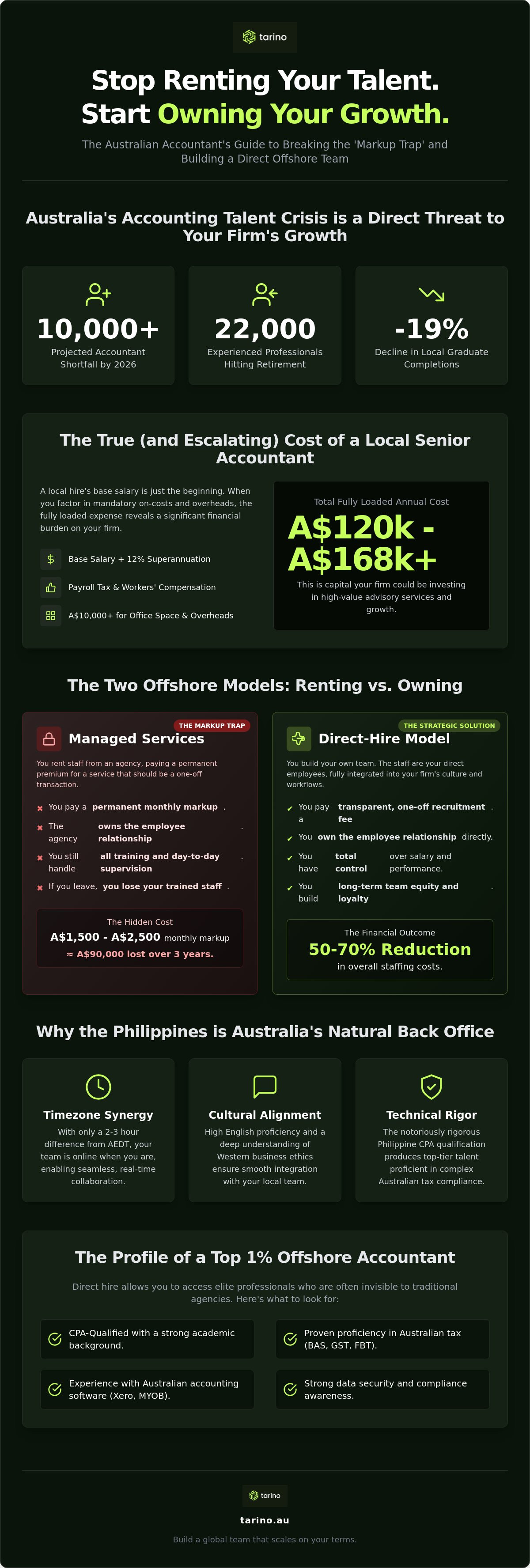
You're likely feeling the squeeze. With a projected shortfall of over 10,000 accountants across Australia by 2026 and local fully loaded costs for seniors often reaching A$168,000, the maths simply doesn't work anymore. You need senior talent that understands Australian tax law without the eye-watering local price tag. You're tired of hidden agency fees and the constant fear of quality control issues or data breaches from unmanaged teams.
This guide reveals how to reclaim your margins by shifting to a direct-hire model. We'll show you how to reduce staff costs by 50-70%, access the top 1% of CPA-qualified talent in the Philippines, and maintain total control over your workflows. It's time to stop paying for "managed services" you don't need and start building a firm that scales on your own terms.
Key Takeaways
- Eliminate permanent agency markups and reduce your staffing overheads by 50-70% by shifting to a transparent direct-hire model.
- Understand why the most profitable way to hire offshore accountants australia provides is to own the relationship directly rather than renting staff from a middleman.
- Access senior, CPA-qualified talent in the Philippines with proven proficiency in Australian tax compliance, including BAS, GST, and FBT returns.
- Solve the 2026 talent shortage by building a high-capacity team that you manage exactly like your local staff, without the friction of managed service contracts.
- Learn how to identify and vet the top 1% of offshore professionals who are often invisible to firms using traditional job boards or basic recruitment agencies.
Scaling Your Firm in 2026: The Reality of the Australian Accounting Talent Shortage
The talent pool is dry. By mid-2026, Australia faces a projected shortfall of over 10,000 qualified accountants. With 22,000 experienced professionals hitting retirement age and graduate completions down by 19%, the local market isn't just tight; it's structurally broken. This mirrors the challenges in other essential sectors like healthcare, where the demand for qualified staff has led to a reliance on specialised agencies like Barton Care to provide personal care assistants and nurses. For boutique and mid-sized firms, the struggle to find senior tax accountants has moved from a nuisance to a genuine business risk. If you can't find the staff to do the work, you can't grow. It's that simple.
Choosing to hire offshore accountants australia wide is no longer a desperate cost-cutting measure. It's a strategic necessity for capacity building. Forward-thinking firms have stopped viewing offshoring as "cheap help" tucked away in a corner. Instead, they're embracing global team integration. They're building hybrid offices where a senior accountant in Manila is just as vital to the firm's culture as a manager in an Australian office. This shift allows onshore staff to focus on high-value advisory work—much like the performance-focused insights provided by a business accountant perth—while the offshore team handles the heavy lifting of compliance and processing.
The True Cost of Local Recruitment in 2026
Local recruitment is a bidding war you're likely to lose. When you hire locally, the base salary is just the starting point. By July 2026, the "Payday Super" legislation requires you to pay the 12% superannuation guarantee at the same time as wages. Add payroll tax, workers' compensation, and the A$10,000-plus per year for a physical desk in a CBD office. A local senior accountant with a base salary of A$82,000 quickly costs your firm upwards of A$120,000. Meanwhile, SMEs are losing the talent war to Big 4 firms that can offer salaries and perks that smaller practices can't match. Every month a seat remains vacant is a month of lost billable hours and stunted revenue.
Why the Philippines is Australia's Natural Back Office
The Philippines remains the gold standard for Australian firms for three reasons: timezone, culture, and rigor. With only a two to three-hour difference from AEDT, your offshore staff are online when you are. This allows for real-time collaboration that 24-hour cycles in Europe or India can't offer. The cultural synergy is equally strong, with high English proficiency and a deep understanding of Western business norms.
The technical standards are also exceptionally high. The Philippine CPA qualification is notoriously rigorous, ensuring a level of detail and accuracy that rivals domestic standards. While Business process outsourcing has evolved significantly, the direct-hire model ensures you get the top 1% of this talent. You aren't just getting a "resource"; you're getting a qualified professional who understands the importance of Australian compliance and rigorous data security.
Direct Hire vs. Managed Services: Breaking the 'Markup Trap'
Most Australian firms fall into the managed services trap because it feels like the path of least resistance. The agency promises to handle everything from payroll to "supervision" for a flat monthly fee. It sounds convenient. In reality, it's a financial treadmill. You're effectively renting your staff, paying a permanent premium for a recruitment service that should have been a one-off transaction. When you hire offshore accountants australia wide through a direct-hire model, you stop paying that agency tax and start building actual equity in your team.
The difference is ownership. In a managed service model, the agency owns the relationship, the contract, and often the loyalty of the staff member. If you leave the agency, you lose the talent. Direct hire flips this. You pay a one-off recruitment fee, and the staff member becomes a direct employee of your firm. You control the salary, the performance reviews, and the long-term career path. This transparency is the only way to protect your firm's margins as you scale.
The Hidden Math of Monthly Markups
Let's look at the numbers. A typical managed service provider might add a A$1,500 to A$2,500 monthly markup on top of a senior accountant's salary. Over a three-year contract, that's up to A$90,000 in "management fees" for a staff member you are already training and supervising yourself. That is capital that should be staying in your practice. Furthermore, the Tax Practitioners Board's offshoring guidance makes it clear that the Australian practitioner remains responsible for the work. If you're doing the oversight, why are you paying an agency a monthly fee to "manage" the desk?
Taking the Reins: Direct Management for Professional Services
Managing your offshore team directly isn't just about cost; it's about culture. When staff feel like they belong to an agency, their commitment to your firm's specific SOPs and values is diluted. By removing the middleman, you integrate your Philippine staff directly into your existing ecosystem. They use your Xero, MYOB, or APS workflows. They attend your weekly Zoom huddles. They become part of the firm's fabric.
Direct communication eliminates the "supervisor bottleneck" common in managed services. You don't need to pass instructions through an agency manager who doesn't understand the nuances of a complex Division 7A issue or a specific client's history. You speak directly to your team. This level of integration is what drives retention. If you want to see how this transition works in practice, you can explore specialised recruitment models that prioritise direct firm-to-staff relationships.
The math is simple. The agency model prioritises their recurring revenue. The direct-hire model prioritises your firm's profitability. It's time to stop renting and start building.
Assessing Quality: Qualifications and Australian Tax Proficiency
Quality is the primary concern for any partner looking to hire offshore accountants australia. You aren't looking for basic data entry; you need professionals who understand the nuances of the Australian tax system. The good news is that the Philippine accounting standard is world-class. Most candidates hold a five-year degree and have passed a CPA board exam with pass rates that often sit below 25%. This creates a filtered, high-calibre talent pool that is technically proficient and ready for the rigours of Australian compliance.
Technical proficiency isn't just about general accounting principles. It's about knowing the specific rhythm of the Australian financial year. High-quality offshore staff arrive with deep experience in GST compliance, BAS preparation, and FBT returns. They understand the difference between a Division 7A loan and a standard dividend. For firms with more complex needs, you can find specialists in SMSF administration and trust accounting who are already comfortable with the compliance requirements of the ATO and ASIC.
Software mastery is a given with the top 1% of talent. Most senior offshore accountants are "Xero champions" or QuickBooks experts. They don't just use the software; they understand how to leverage practice management tools like Karbon, GreatSoft, or APS to keep your workflows moving. This technical fluency means your training time is spent on your firm's specific preferences, not on teaching the basics of the cloud accounting ecosystem.
The 'AU-Ready' Checklist for Candidates
Technical skills are only half the battle. A candidate needs to be "AU-Ready" from day one to minimise your management overhead. An 'AU-Ready' accountant is defined as a professional who has at least 3 years of experience in an AU-facing BPO. This ensures they already understand Australian lodgement deadlines and are comfortable navigating the ATO and ASIC portals. Look for candidates who can demonstrate:
- Experience with Australian business structures, including discretionary trusts and PTY LTD companies.
- A proven track record of meeting quarterly BAS and IAS deadlines without constant supervision.
- Familiarity with Australian payroll requirements, including the 2026 "Payday Super" changes.
Soft Skills that Matter for Australian Firms
Communication is the bridge between a task-taker and a proactive advisor. You need a team member who doesn't just wait for instructions but highlights potential issues before they become problems. This requires critical thinking and a high degree of English proficiency. Alignment with Australian Eastern Daylight Time (AEDT) is also essential. When your offshore team is online for your morning huddles, they become an integrated part of your daily operations, allowing for real-time problem-solving and immediate client query responses. This synergy is what transforms an offshore hire into a long-term strategic asset.
The Recruitment Blueprint: Finding and Vetting the Top 1%
Hiring from a job board is a lottery you'll probably lose. The "Top 1%" of talent in the Philippines are rarely actively looking for work. They are already well-compensated, secure, and respected in their current roles. To find them, you need a proactive headhunting strategy, not a passive advertisement. If you want to hire offshore accountants australia can actually rely on for senior-level work, you must move beyond the surface-level applications and "CV-padders" who flood the major platforms.
The reality is that many candidates exaggerate their Australian experience. They might list "AU Tax" because they once spent six months doing basic data entry for a Perth-based firm. True expertise is deeper. Vetting requires a ruthless filter that prioritises technical accuracy and cultural alignment over a polished resume. You need a partner who can distinguish between someone who follows a checklist and someone who understands the "why" behind a complex tax structure.
Step 1: Defining the Role and the 'On-Costs'
Start with clarity. A vague job description attracts vague talent. If you need a senior professional to handle complex discretionary trusts and Division 7A issues, don't write a job ad for a bookkeeper. Precision matters. You also need to set a competitive salary that reflects the 2026 Manila market. Attempting to lowball the top tier of talent is a recipe for high turnover. Finally, organise your infrastructure early. Secure VPN access and high-spec hardware are non-negotiable requirements that must be ready before day one to avoid operational friction.
Step 2: The Technical and Cultural Deep-Dive
Resume padding is a structural problem in global recruitment. We solve this by administering rigorous Australian tax tests as a mandatory first step. If a candidate cannot accurately prepare a BAS or explain the treatment of GST in a specific scenario, they don't progress. Video interviews follow, allowing us to assess English fluency and the ability to act as a proactive advisor rather than a passive task-taker. We look for critical thinkers who will challenge a discrepancy rather than just "keying it in."
Reference checking is the final, most important hurdle. We don't just call the numbers provided; we dig into their previous experience with Australian firms to verify their technical claims and reliability. Once hired, the first 90 days should be governed by clear, measurable KPIs. This setting of expectations ensures your new hire understands exactly what "success" looks like in your firm. If you're ready to skip the job board lottery and find a genuine expert, you can start your offshore recruitment search with a team that specialises in the Philippine market.
Strategic Implementation: How Tarino Simplifies Your Offshore Move
Transitioning to a global team is a strategic pivot, not just a recruitment task. Most firms hesitate because they fear the operational friction of managing staff across borders. Tarino removes that barrier. We don't just provide a list of names; we provide a curated selection of the top 1% of talent, pre-vetted for technical rigor and cultural alignment. When you hire offshore accountants australia wide through our model, you aren't dealing with a generic BPO. You're working with a specialist partner that understands the specific demands of the Australian accounting industry.
The process is designed for efficiency. We handle the heavy lifting of sourcing, technical testing, and initial interviewing. You make the final call. This approach ensures you maintain direct management of your team from day one. There is no agency middleman filtering your instructions or diluting your firm's culture. You get the expertise you need without the administrative headache. It's a cleaner, more profitable way to scale.
Why a Specialist Recruiter Beats a Generalist Agency
Generalist agencies find "resources." We find professionals. Our focus on Australian professional services means we know the difference between a bookkeeper and a Senior Tax Accountant who can navigate complex trust structures. We maintain a pre-vetted database of Philippine accounting talent specifically experienced in AU compliance. This focus reduces your time-to-hire from months to weeks. You don't have to explain what a BAS is to us; we've already tested the candidates on it. This level of industry-specific knowledge is what separates a premium recruitment service from a standard labour hire firm.
Scaling becomes a repeatable system rather than a series of one-off hires. Whether you're looking for your first offshore VA or building a full back-office accounting team, the framework remains the same. You gain a competitive edge by keeping your onshore staff focused on high-level advisory work while your Philippine team handles the essential compliance and processing. This is the end game for high-growth firms: a leaner, more resilient practice with significantly higher margins.
Ready to Cut the Markup?
The 2026 landscape demands a new approach. With rising superannuation costs and a deepening talent shortage, the managed service model is a luxury your firm can no longer afford. Direct hire is the only logical alternative for firms that value transparency and long-term profitability. The process is simple, direct, and focused on results. If you're ready to move away from ongoing markups and take full control of your team, it's time to act. Book a strategy call to find your next offshore accountant and discover how a direct-hire strategy can transform your firm's capacity.
Future-Proof Your Practice with a Global Edge
The Australian accounting landscape in 2026 doesn't reward hesitation. With a structural talent shortage and rising local overheads, the firms that thrive will be those that embrace a high-performance global workforce. You've seen the data. You know that "renting" staff through managed service agencies is a permanent tax on your growth that erodes long-term margins. Choosing to hire offshore accountants australia through a direct-hire model is the only logical way to reclaim your profitability while maintaining total control over your firm's standards and culture.
Tarino provides the antidote to high-markup outsourcing. We specialise in recruitment for AU accounting firms, giving you exclusive access to the top 1% of Philippines-based talent without the burden of ongoing seat fees or hidden markups. You get the technical rigour of a CPA-qualified professional with the financial flexibility your firm needs to scale. It's time to build a team that belongs to your firm, not an agency.
Scale your firm with a direct-hire offshore accountant from Tarino. Your firm's next chapter of growth starts with one strategic hire. Let's find the talent that moves the needle for your practice.
Common Questions About Hiring Offshore Accountants
How much can I realistically save by hiring an offshore accountant in the Philippines?
You can realistically reduce your staffing costs by 50% to 70% compared to local Australian hires. While a senior local accountant often costs a firm upwards of A$160,000 once superannuation and overheads are factored in, a high-quality Philippine professional typically costs between A$30,000 and A$45,000. These savings allow you to reinvest in growth or advisory services while maintaining healthy margins.
Do offshore accountants understand Australian tax laws like GST and FBT?
Yes, the top tier of Philippine accountants have deep experience with Australian compliance. When you hire offshore accountants australia firms rely on, they are typically pre-vetted for their knowledge of GST, BAS preparation, and FBT returns. Many have spent years working exclusively for Australian clients in specialised BPOs, ensuring they hit the ground running with your firm's specific tax workflows.
Is my firm's data secure when working with an offshore team?
Data security depends on your firm's internal protocols and the tools you provide. By using cloud-based platforms like Xero or MYOB and enforcing multi-factor authentication, your data remains in the cloud, not on a local machine in Manila. We recommend using secure VPNs and restricted access levels to ensure your client information is handled with the same rigour as it is in your Australian office.
What is the difference between a managed service and Tarino's direct-hire model?
The difference is between "renting" and "owning" your talent. A managed service charges a permanent monthly markup or "seat fee" on top of the staff member's salary. Tarino's direct-hire model involves a one-off recruitment fee. Once the hire is made, you manage the staff member directly and pay their salary without an agency taking a cut every month.
Do I need to set up a Philippine entity to hire staff directly?
You do not need to set up a Philippine entity. Most Australian firms use a third-party payroll or Employer of Record (EOR) service in the Philippines to handle local tax and compliance. This allows you to manage the staff member's day-to-day work directly while the administrative and legal complexities of international employment are handled by specialists.
How do I manage the performance of someone working remotely in Manila?
Managing a remote team in Manila is identical to managing a remote team in Sydney. Use real-time communication tools like Slack or Microsoft Teams and project management software like Karbon or Xero Practice Manager. Because the Philippines is only two to three hours behind AEDT, you can conduct morning huddles and live training sessions just as you would with local staff.
What happens if the offshore accountant doesn't work out during the trial period?
If a candidate doesn't meet your expectations during the initial period, standard recruitment protections apply. Tarino provides a replacement guarantee to ensure your firm isn't left with a vacancy. We focus on rigorous technical testing and cultural vetting upfront to minimise this risk, but we remain your strategic partner if a hire doesn't align with your firm's specific needs.
Which accounting software is most commonly used by offshore staff in the Philippines?
Xero is the dominant platform for offshore accountants in the Philippines, but proficiency in QuickBooks and MYOB is also common. Most senior candidates are also well-versed in Australian practice management tools like APS, GreatSoft, and Karbon. Their technical fluency means you won't waste time teaching software basics; you can focus on your firm's unique processes instead.