

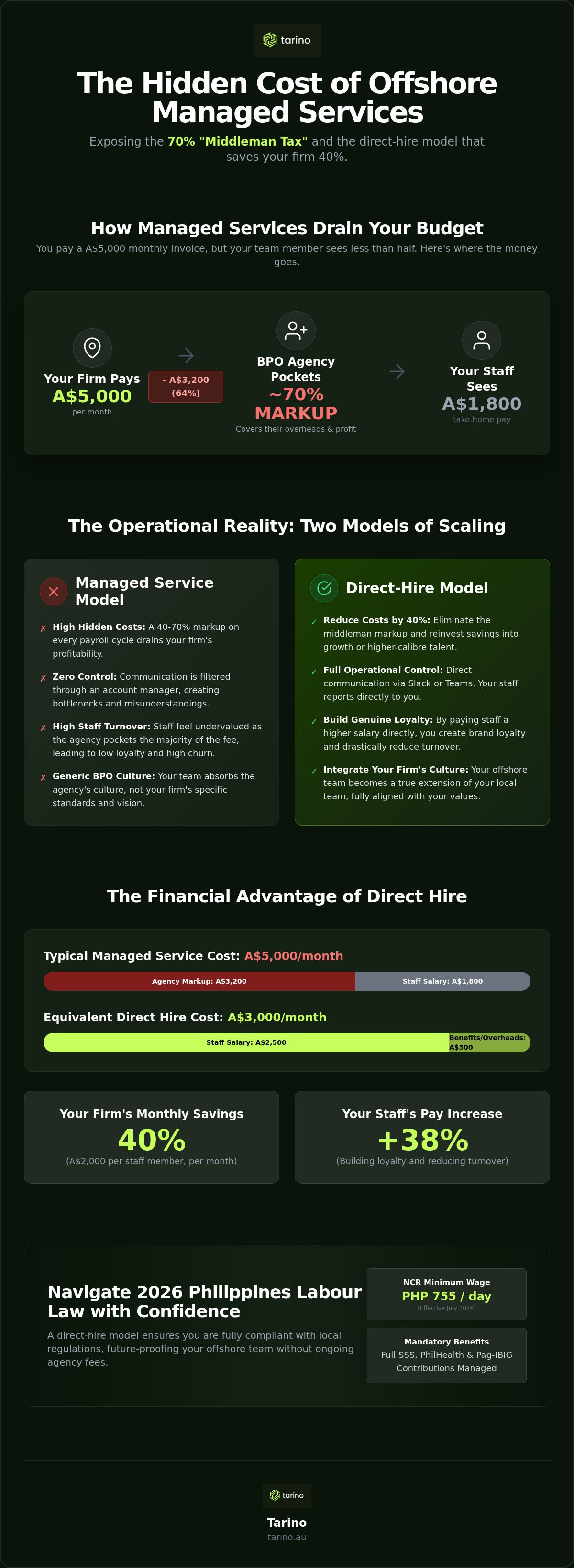
Your managed service provider is likely pocketing a 70% markup on every hour your offshore team works. It is a "convenience tax" that drains your firm's margins and stifles staff loyalty. You see the monthly invoice for A$5,000, but your staff member sees less than half. This model is built for the agency's profit, not your firm's growth. It is an outdated way to scale that leaves you with high turnover and zero control over your own office culture.
We understand the frustration of being disconnected from the people doing your work. This guide provides the strategic roadmap to hire offshore staff without markups, allowing you to reduce staffing costs by 40% while regaining direct management. You will learn how to bypass the middleman and build a high-performing Philippines team that stays loyal to your brand. We will cover the 2026 regulatory landscape, including the latest SSS contribution rates and the July 2026 NCR minimum wage increase to PHP 755, ensuring your direct-hire model is both profitable and compliant.
Key Takeaways
- Eliminate the "middleman tax" by identifying where managed service providers hide their 70% markups on your offshore payroll.
- Discover the proven framework to hire offshore staff without markups, allowing you to reduce operational costs by 40% while increasing staff take-home pay.
- Shift from a managed service model to direct management to improve staff loyalty and ensure your Philippines team is fully integrated into your firm’s culture.
- Learn how to source high-value talent for specialised roles, including Accountants and Mortgage Broker support, that meet Australian professional standards.
- Navigate 2026 Philippines labor laws and mandatory benefits with confidence, ensuring full compliance without the need for an expensive ongoing agency.
The Hidden Cost of the Managed Service Markup
Most Australian business owners view Business Process Outsourcing (BPO) as a shortcut to efficiency. It isn't. It is a bloated middleman model designed to extract maximum margin from your payroll budget. When you receive a monthly invoice for a staff member, you aren't just paying for their talent. You are subsidising the BPO’s premium office space in Manila, their massive HR departments, and their executive bonuses. This "middleman tax" is a direct drain on your firm’s profitability and a barrier to genuine team integration.
The 40-70% Premium You Didn’t Sign Up For
The math is simple but painful. In a managed service model, the markup often sits between 40% and 70%. If you pay A$5,000 a month for an offshore Accountant, that staff member might only see A$1,800 in their bank account. The remaining A$3,200 is lost to the agency. Over a three-year tenure, this markup compounds into a staggering sum that could have been reinvested into your firm’s growth or higher-quality talent. To truly scale, you must learn how to hire offshore staff without markups. Continuing to "rent" your talent through an agency creates a massive opportunity cost. You pay a premium for a relationship where you own nothing and control very little.
Understanding What is offshoring? is the first step toward reclaiming your margins. While traditional outsourcing hands over control to a third party, true offshoring through a direct-hire model allows you to keep the operational reins. By removing the middleman, you convert an ongoing monthly expense into a strategic asset. You aren't just filling a seat; you are building a team that actually belongs to your firm. It is the difference between a temporary fix and a long-term competitive advantage.
Why Managed Services Lead to High Staff Turnover
Managed service providers often claim they offer better retention. The reality is the opposite. When a staff member knows their agency is pocketing more than half of what the Australian firm pays, resentment builds. This salary gap is the primary driver of the Philippines' high turnover rates. In 2026, with the National Capital Region minimum wage having increased to PHP 755 per day, staff are more conscious of their market value than ever. If they don't feel fairly compensated, they will leave for the first direct-hire offer that comes their way.
Direct hiring fixes this retention leak. When you hire offshore staff without markups, you can afford to pay a salary that is significantly higher than the BPO average while still saving 40% on your total spend. This creates immediate brand loyalty. The staff member no longer works for "the agency"; they work for you. They are integrated into your culture, they understand your Australian standards, and they have a clear career path within your organisation. Stability isn't something you can buy from a BPO; it is something you build through direct relationships.
Direct Hire vs. Managed Services: Operational Reality
Managed services are essentially a "rent-a-person" scheme. You don't own the relationship; the agency does. This creates a permanent barrier between your firm and your staff. When you choose to hire offshore staff without markups, that barrier vanishes. Your staff member isn't an agency resource; they are a member of your team. They use your firm's email domain, they follow your specific security protocols, and they report directly to you. The operational clarity this provides is the foundation of a scalable professional services firm.
The "Account Manager" bottleneck is a classic managed service failure. In a BPO, you are forced to communicate through a middleman who doesn't understand your clients or your workflows. It is slow. It is frustrating. In a direct-hire model, communication is instant. You use Slack, Teams, or Zoom just as you would with a local employee in Sydney or Melbourne. This direct line of sight ensures that tasks are completed accurately and feedback is implemented immediately. You gain the agility to pivot your strategy without waiting for an agency's approval.
Ownership of Firm Culture and Process
BPO culture is generic. It is designed for volume, not the high-precision requirements of Australian accounting or legal firms. If your offshore staff sit in a crowded BPO office, they absorb that agency's transactional mindset. Direct hiring allows you to integrate them into your firm's unique culture. You can bring them into your Monday morning huddles and share your long-term vision. You train them your way, using your specific software stack and quality standards. This level of integration is impossible when an agency sits between you and your talent.
The Math of the One-Off Recruitment Fee
Firm owners often hesitate at the upfront cost of a recruitment fee. This is a short-term perspective. A one-off fee is a capital investment; a monthly markup is a permanent tax on your revenue. When you compare a single placement fee to 36 months of agency markups, the direct-hire model usually pays for itself in less than six months. This approach frees up significant capital that can be reinvested into hiring senior local staff or upgrading your firm's technology. If you want to build a real asset, you need to stop renting your workforce.
Managing this transition requires a basic understanding of labor laws in the Philippines to ensure your direct-hire contracts are robust and compliant. While the legal framework is different, it is entirely manageable for any professional firm. If you are ready to stop paying the middleman and start building a dedicated team, exploring specialised Philippines recruitment is the logical next step for your firm's 2026 growth strategy.
Sourcing the Top 1% of Philippines Talent
Most firms fail because they hire for price, not proficiency. A generalist virtual assistant cannot manage your trust account or lodge a BAS. You need professionals who understand the Australian regulatory environment. To hire offshore staff without markups successfully, your recruitment process must be as rigorous as your local hiring. You aren't just looking for a remote worker. You are looking for a specialist who can hit the ground running with Xero or MYOB.
Technical skill is only half the battle. Cultural fit and communication are what define the top 1%. High-performing professionals in Manila are increasingly moving away from the "churn and burn" BPO model. They want stability. They want to be part of a real team. This shift is a key part of any modern guide to managing remote workers. When you offer a direct-hire role, you immediately attract a higher calibre of candidate who values professional autonomy over agency-mandated micromanagement.
Vetting for AU Professional Standards
Generic vetting is useless for specialised firms. If you are hiring an Accountant, they must demonstrate a deep understanding of Australian tax residency rules and GST. For Mortgage Broking support, we vet for candidates who can navigate the Australian lending landscape and understand the compliance requirements of major and non-bank lenders. Legal support roles require proficiency in Australian administrative tasks and document management systems. We don't settle for "close enough". We hire for precision.
Our interview process is designed to be a filter, not a funnel. We discard the generic scripts. Instead, we focus on technical case studies and role-specific testing. Can the Accountant reconcile a complex trust account? Can the Broker Support officer identify a missing document in a loan application? This rigor is what separates a successful offshore strategy from an expensive mistake. You deserve a team that adds value from day one.
The "Top 1%" Strategy: Attracting Career-Minded Professionals
We identify technical excellence by simulating real-world scenarios. This ensures every placement meets the high standards expected by Australian professional services firms. You aren't just hiring a worker; you are investing in a future leader for your firm. By offering a direct relationship, you secure the loyalty of talent that would otherwise be lost in the agency machine.
How to Manage Direct-Hire Offshore Staff
The BPO industry survives on a single myth: that managing offshore staff is too complex for an Australian firm to handle alone. It isn't. When you hire offshore staff without markups, you aren't just saving money; you are removing a layer of bureaucratic noise that often hinders performance. Management is simply about clear expectations, the right tools, and direct communication. You don't need a middleman to tell your staff what to do. You just need a system.
Effective management starts with treating your offshore team as an extension of your local office, not a separate department. Use the same communication channels, the same project management software, and the same performance standards. When you remove the agency buffer, you gain the ability to foster genuine accountability. Your staff members know exactly who they are working for and what success looks like in your firm.
Infrastructure and Security Essentials
Professional services firms in Australia have strict data obligations. You don't need a BPO’s "secure facility" to meet these. Modern cloud-based tools like Xero, Practice Ignition, and Microsoft 365 provide enterprise-grade security regardless of where your team sits. Use a password manager to control access without ever sharing raw credentials. For hardware, don't settle for the outdated machines often provided by managed service agencies. Buying your staff high-quality gear directly ensures they have the tools to perform at an Australian standard from day one.
Payroll and Compliance Simplified
Paying your team in the Philippines is now as efficient as paying a local contractor. Platforms like Wise allow you to send A$ directly to their bank accounts with minimal fees and transparent exchange rates. You remain in control of the total cost, ensuring your staff receive their full salary without hidden agency cuts. This transparency is a massive driver of loyalty.
Compliance is equally straightforward when you know the rules. You must pay the mandatory 13th-month pay, equivalent to one month’s basic salary, by 24th December each year. Additionally, factor in the Social Security System (SSS) contribution rate, which for 2026 is 15% of the Monthly Salary Credit, with the employer covering 10%. By handling these requirements directly, you build a culture of fairness that no managed service provider can replicate. If you are ready to take back control of your operations, it is time to build your dedicated Philippines team with a partner who understands the direct-hire advantage.
Scaling with the Tarino Direct-Placement Model
Scaling an Australian professional services firm requires a lean, efficient back office. The traditional BPO model is the opposite of lean. It is a heavy, expensive structure that creates a permanent tax on your growth. Tarino was built as the antidote to this bloat. We don't want to manage your staff; we want to find you the best people so you can manage them yourself. Our model is built on a simple premise: you should own your team, not rent it.
When you hire offshore staff without markups through Tarino, you are choosing a path of total operational transparency. We handle the heavy lifting of specialised recruitment, vetting candidates against rigorous Australian standards. Once the placement is made, the relationship is yours. There are no ongoing fees, no hidden margins, and no agency middlemen. This shift from "rental" to "ownership" is how boutique firms compete with the big end of town.
Why a Recruitment-Only Approach Wins
Managed services profit from your inertia. They want you to stay dependent on their infrastructure so they can continue collecting their 70% markup. Tarino’s recruitment-only approach aligns our incentives with yours. We focus exclusively on finding high-calibre talent for specialised roles like Accountant Recruitment and Mortgage Broker Support. Our success is measured by the quality and longevity of the placement, not by how much margin we can extract from a monthly invoice.
This model provides the ultimate flexibility. You aren't locked into restrictive, long-term agency contracts that make it difficult to pivot. If your firm needs to scale up quickly or refine its structure, you have the freedom to do so. We have seen Australian firms save upwards of A$40,000 per seat annually by switching from a managed service to our direct-placement model. That is capital that can be reinvested into local senior hires, marketing, or firm technology.
Getting Started: Your Path to a Leaner Back Office
Moving to a direct-hire model is a structured process. It begins with a deep-dive discovery call where we define your firm’s specific technical requirements and cultural nuances. We don't provide generic "VAs". We find specialised professionals who understand your industry. From the initial brief to the start date, our recruitment timeline is designed for speed and precision, typically taking 4 to 6 weeks to secure the top 1% of talent.
The operational reality of 2026 is that firms must be agile to survive. You cannot afford to subsidise an agency’s overheads while your own margins are under pressure. It is time to reclaim your profit and your culture. Book a strategy session with Tarino to audit your offshore costs and discover how a direct-hire team can transform your firm’s bottom line.
Take Control of Your Firm’s Future
The managed service model is a relic of an era when business owners didn't understand the Philippines market. In 2026, the data is clear. Paying a 70% markup for "convenience" is a strategic failure that erodes your margins and alienates your best talent. By choosing to hire offshore staff without markups, you reclaim your profit and build a team that actually belongs to your organisation. You move from being a client of an agency to being a leader of a global team.
Tarino specialises in high-value recruitment for Australian Accounting, Legal, and Finance roles. We replace the ongoing "middleman tax" with a simple, one-off recruitment fee model. This approach ensures direct ownership of your offshore team, fostering a culture of loyalty and professional excellence that no BPO can replicate. It is time to stop subsidising an agency's overheads and start investing in your own firm's growth. Stop paying markups and start building your direct-hire team today.
Building a leaner, more profitable back office isn't just a cost-saving measure. It is a competitive necessity. You now have the roadmap to scale with agility and confidence. Let's get to work.
Frequently Asked Questions
Is hiring offshore staff directly legal for Australian firms?
Yes, it's entirely legal to engage Philippines-based staff as independent contractors or through a direct-hire agreement. Your firm enters into a professional services contract with the individual. You must ensure your data privacy protocols and employment contracts align with both Australian standards and the Philippine Labor Code to protect your firm's interests.
How do I handle payroll for a direct hire in the Philippines?
You can manage payroll efficiently using international payment platforms like Wise or specialised global payroll software. These tools allow you to pay in A$ while the staff member receives PHP at transparent exchange rates. Remember to account for mandatory contributions such as the Social Security System (SSS) rate, which is 15% in 2026, and the 13th-month pay due by 24th December.
What happens if the direct-hire staff member doesn’t work out?
You manage poor performance through standard probation periods and performance improvement plans, just as you would in Australia. Most specialised recruitment models include a replacement guarantee if a candidate isn't the right fit within the first few months. This mitigates the risk while allowing you to maintain a high standard of talent within your firm.
Do I need to set up a Philippines entity to hire directly?
No, you don't need a local Philippines entity to hire offshore staff without markups. Most Australian firms engage staff as remote contractors. This avoids the administrative burden and cost of setting up a foreign branch while still giving you full control over the staff member's daily tasks and integration into your firm's culture.
How does direct hire compare to using an EOR (Employer of Record)?
An EOR acts as the legal employer and handles compliance for a monthly fee, whereas direct hire removes the middleman entirely. EOR services are useful for large-scale operations, but they still involve an ongoing fee that eats into your margins. Direct hiring is the most cost-effective path for firms wanting maximum profit and direct communication with their team.
What is the typical timeframe to find a specialised offshore accountant?
Finding a high-calibre, specialised professional typically takes between four and six weeks. This timeframe allows for a rigorous vetting process, including technical skills testing for Australian tax residency and proficiency in software like Xero. It's a methodical approach that prioritises quality over the "quick fix" often found in generic BPO pools.
How do I manage time zone differences with my Philippines team?
The Philippines is only two hours behind AEST (three hours during Daylight Saving), making it one of the most compatible offshore locations for Australian firms. Most staff are happy to shift their start times to align perfectly with your office schedule. This overlap ensures real-time communication and seamless integration into your daily huddles and workflows.