

Most offshore business cases fail because they focus on saving cents while losing thousands in hidden management fees and lost quality control. If you are tired of the revolving door of junior AU staff and the opaque markups of traditional outsourcing, it is time for a more sophisticated approach. Building a robust business case for direct hire offshoring is no longer about finding the cheapest labour in the Philippines; it is about reclaiming your firm’s profit margins and operational sovereignty.
We understand the pressure. Local wage hikes and the 2025 criminal wage theft laws have made domestic scaling feel like a high-risk gamble. This guide provides the exact ROI framework you need to present to your board or partners. You will learn how to bypass high-cost managed services, ensure strict ATO compliance, and build a specialised back-office team that operates as a true extension of your firm. We are moving past the "rent-a-staff" mindset to a model where transparency and quality are the non-negotiable standards. It is time to stop settling for service providers and start building a scalable asset.
Key Takeaways
- Shift the internal narrative from "cheap labour" to capacity building by identifying the specific bottlenecks that currently drain your partners' high-value advisory time.
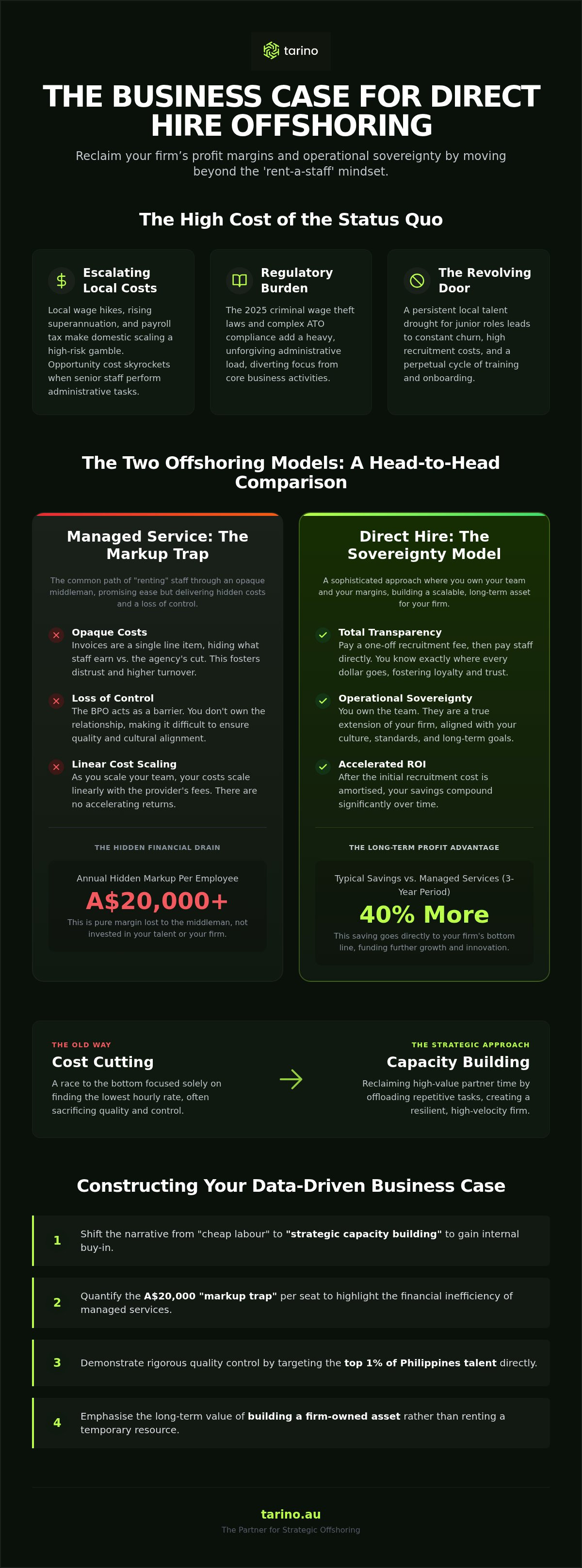
- Uncover the "markup trap" where managed service fees can cost your firm A$20,000 extra per seat annually compared to a business case for direct hire offshoring.
- Maintain rigorous quality control by targeting the top 1% of Philippines talent, proving you don't need an expensive middleman to uphold Australian professional standards.
- Build operational sovereignty by owning your team and your margins instead of renting them from an opaque third-party provider.
- Follow a structured ROI framework to present a data-driven argument to your board that prioritises long-term margin protection and scalability.
Defining the Strategic Objective: Capacity Building vs. Cost Cutting
The old way of thinking about offshoring is dead. If your strategy is built solely on finding the lowest hourly rate, you aren't building a business; you're managing a race to the bottom. A sophisticated business case for direct hire offshoring prioritises capacity over cost. It’s about reclaiming your partners' time so they can focus on high-value advisory work instead of being buried in compliance grunt work. While the broad definition of offshoring covers various models, for an Australian firm in 2026, the only model that makes sense is direct ownership. External BPOs often act as a barrier between you and your staff. Direct hire gives you the control you need to ensure quality and cultural alignment. You aren't just hiring a "resource"; you are building a scalable asset that stays with your firm.
The True Cost of Local Recruitment in 2026
Hiring in Australia has never been more expensive or complex. Beyond the base salary, you are looking at escalating superannuation rates, payroll tax, and the soaring cost of premium office space in Australia's major cities. Then there’s the regulatory risk. With criminal wage theft laws in effect since January 2025, the administrative burden of local compliance is heavy and unforgiving. The local talent drought isn't a temporary phase; it's a structural reality. When senior AU staff spend 30% of their week on repetitive data entry or basic loan processing, you aren't just paying a premium for admin. You are losing the opportunity to bill for high-level strategy. This opportunity cost is the hidden killer of firm profitability.
Capacity as a Competitive Advantage
Imagine your local team starting their day with the "grunt work" already finished. By identifying specific bottlenecks in data entry, compliance, or financial reporting, you can create a seamless, high-velocity workflow. A Philippines-based team provides a "follow-the-sun" advantage, ensuring urgent legal files or mortgage applications move forward while your AU office is closed. This isn't about replacing your local staff; it's about protecting them from burnout. When you offload the repetitive tasks, your Australian team can focus on what they do best: building client relationships and driving revenue. This creates a more resilient practice that can hit 2026 growth targets without the constant churn of junior staff. Capacity is no longer just a metric; it is your ultimate competitive advantage—one that allows firms like The Bucket List Accountant to focus on strategic financial advisory for their clients.
The Financial Model: Direct-Hire vs. Managed Service Markups
The financial core of any business case for direct hire offshoring rests on one word: transparency. Many Australian firms fall into the "Markup Trap" by opting for managed services that promise ease but deliver high ongoing costs. These providers often charge a monthly management fee that can exceed A$1,500 per seat. Over a year, you are paying upwards of A$20,000 extra for a middleman. By switching to a direct-hire model, you pay a one-off recruitment fee and then pay the staff directly. This shift moves the margin from the provider's pocket back into your firm's bottom line. It's the difference between renting an asset and owning it.
When you apply a strategic offshoring framework, you realise that owning the relationship is the only way to protect your long-term ROI. In a managed service model, you are essentially "renting" your team. If you want to scale, your costs scale linearly with the provider's fees. With direct hire, your savings accelerate significantly after the first six months once the initial recruitment cost is amortised. Over a three-year period, direct-hire models typically save firms 40% more than managed alternatives. You aren't just saving on labour; you are reclaiming your firm's future profitability.
Decoding the Managed Service Invoice
The biggest frustration for AU partners is the transparency gap. Managed service invoices are often a single line item. You don't know what the staff member is actually earning versus what the agency is pocketing. This opaque structure often leads to higher staff turnover because the employee isn't receiving a "fair go." When you hire directly, you know exactly what your team is paid. This transparency fosters loyalty. It allows you to offer competitive local health benefits and 13th-month pay without an agency taking a hidden cut. Your team feels like part of your firm, not a line item in a third-party's ledger.
Calculating Total Cost of Ownership (TCO)
A realistic TCO must account for more than just the base salary. You need to budget for Philippines-specific requirements like the mandatory 13th-month pay and private health insurance (HMO). Even with these additions, the cost remains a fraction of local AU rates. For example, when you hire offshore accountants australia, the total cost of ownership is significantly lower because you aren't paying a perpetual management tax. You own the infrastructure and the relationship. If you're ready to see how these numbers stack up for your specific practice, it pays to consult with a direct-hire specialist who understands the AU professional landscape.
Mitigating Risk: Quality Control and AU-Philippines Alignment
The greatest fear in any business case for direct hire offshoring is the perceived loss of quality. Firms worry that moving tasks 6,000 kilometres away will dilute their professional standards. This fear is usually rooted in a misunderstanding of the difference between offshoring vs. outsourcing. When you outsource to a generic BPO, you lose control. When you offshore via direct hire, you retain it. You don't need a middleman to manage your workflows. You need the right people integrated into your existing systems. It's about ownership, not just delegation.
Quality isn't a geographical trait; it's a recruitment outcome. By targeting the top 1% of Philippines professional talent, you secure staff who are already familiar with the Australian regulatory environment. These are not generalist virtual assistants. They are CPAs, legal analysts, and mortgage specialists who live in Xero, MYOB, and LEAP. They follow your KPIs. They use your checklists. The cultural alignment between Australia and the Philippines is a strategic asset. The shared focus on clear communication and professional hierarchy makes the integration seamless. It's about finding a peer for your local team, not just a pair of hands.
Recruiting for Professional Standards
Professional firms cannot afford learning on the job for Australian tax law or mortgage compliance. You must vet for specific experience. This means testing for high-level English proficiency and technical competence before the first interview. A specialised recruitment partner identifies candidates who have already worked with AU firms. They understand the nuances of our market. This rigour ensures that your offshore team meets the same high standards as your local hires from day one. You aren't just filling a seat; you are hiring for professional parity.
Data Security and Australian Compliance
Compliance is the non-negotiable pillar of your strategy. To meet ATO requirements and the Australian Privacy Principles (APP), you must treat your offshore team like an on-site department. This means implementing secure cloud environments. Use VPNs and Multi-Factor Authentication (MFA) for every login. Direct contracts are essential here. They provide a clear legal framework to protect your intellectual property and client data. By owning the employment relationship, you ensure that security protocols are followed to the letter. You don't have to trust a third party's security; you set the rules yourself.
Step-by-Step: Constructing the Internal Business Case Document
Most firms get stuck in "analysis paralysis". They know the numbers work, but they struggle to get the board across the line. A successful business case for direct hire offshoring isn't just a spreadsheet; it is a narrative of margin protection and scalability for 2026. You need to present a document that addresses the operational reality of your practice while offering a clear, low-risk path forward. It starts with an Executive Summary that focuses on reclaimed partner time and ends with a roadmap that removes the guesswork from the equation.
Your Problem Statement must be data-driven. Use your own metrics on local recruitment times and the escalating cost of junior AU salaries. If it takes you four months to find a local graduate who leaves after eighteen months, that is a structural failure in your capacity model. Contrast this with the financial comparison. Lay out the numbers clearly: the upfront recruitment fee of a direct-hire model versus the perpetual A$20,000 annual "management tax" of a BPO. When the board sees that direct hire allows them to own the relationship and the margin, the logic becomes undeniable.
Winning Over Sceptical Partners
Expect pushback on brand reputation and quality. Address this by proposing a "Pilot Hire". Don't try to move the whole back office at once. Hire one specialised role, such as a mortgage support officer or an AU-tax-trained accountant, to prove the concept. Provide evidence of high-quality output from other Australian firms that have successfully moved away from opaque managed services. When partners see that they can maintain direct control without a middleman, their "fear of the unknown" evaporates. If you want to see how this looks in practice, view our case studies of AU professional firms.
The Implementation Timeline
A vague timeline creates anxiety. Be specific about the milestones.
- Week 1-4: Role definition and targeted sourcing. We don't use generic databases; we headhunt the top 1% of Philippines professional talent.
- Week 5-6: Technical assessments and interviews. You interview the final three candidates to ensure cultural and professional alignment.
- Week 8: Onboarding. Your new staff member is integrated into your cloud systems and AU workflows from day one.
Executing the Case: Why a Recruitment Partner is the Final Piece
You have the strategy. You have the board's approval. Now you need the talent. A business case for direct hire offshoring succeeds or fails at the recruitment stage. Many firms make the mistake of turning to "body shops" that simply sell seats. These providers don't care about your specific workflows or your firm's culture; they care about their monthly management fee. You need a strategic partner who understands that you aren't looking for a "resource," you're looking for a permanent team member who can uphold Australian professional standards.
Tarino is not a generalist agency. We don't recruit for every industry. We focus exclusively on the Australian professional services market. Whether it is Accountant Recruitment or Mortgage Broker Support Recruitment, we understand the technical requirements of your practice. This focus allows us to find "passive" talent that generic job boards miss. We headhunt high-performers who are already working in professional roles and looking for a direct relationship with an AU firm. We find the top 1% so you don't have to settle for the candidates everyone else is fighting over.
The Tarino Advantage for AU Firms
Our model is built on financial clarity and professional rigor. We specialise in Legal Support Recruitment and Financial Planner Support Recruitment, ensuring every candidate has the specific technical background your firm requires. Unlike managed services, we charge one transparent fee for a permanent placement. There are no hidden markups and no ongoing "rental" costs. This ensures your staff member receives a higher take-home pay, which directly translates to higher loyalty and retention. You get a "fair go" for your firm, and they get a "fair go" as an employee. It is a clean, ethical, and highly efficient way to do business.
Starting Your Offshoring Journey
Moving from a theoretical business case to a live search requires a methodical roadmap. Start by booking a strategy session to refine your role descriptions and identify the specific bottlenecks in your AU practice. This is the time to prepare your internal team for their new, integrated offshore colleague. Clear communication is essential; your local staff need to understand that this move is about freeing them from "grunt work" so they can focus on high-value client advisory. A well-prepared firm ensures the onboarding process is smooth and the ROI is immediate. If you are ready to reclaim your margins and scale with confidence, build your offshore team with Tarino today.
Reclaim Your Margins and Your Time
The era of opaque markups and "rent-a-staff" models is over. Your firm deserves a strategy that prioritises operational sovereignty and financial clarity. By shifting the focus from mere cost-cutting to genuine capacity building, you transform your offshore team into a high-performing extension of your local practice. A robust business case for direct hire offshoring is built on the fact that you don't need an expensive middleman to maintain Australian professional standards. You simply need the right talent and a transparent framework.
You now have the roadmap to present a data-driven, risk-mitigated plan to your partners. It is time to stop settling for service providers who erode your margins. We are specialists in AU professional services. We focus on recruiting the top 1% of Philippines talent who understand the nuances of our market. Our direct-hire model ensures zero ongoing markups; you own the relationship and the result. Your firm's future profitability depends on the decisions you make today. It is time to stop overpaying for "managed" mediocrity and start building a scalable asset.
Ready to build your business case? Book a strategy call with Tarino
Frequently Asked Questions
How much can an Australian firm really save by offshoring directly to the Philippines?
Australian firms typically report labour cost savings of 50-70% compared to equivalent local hires. By choosing a direct-hire model, you increase these savings by approximately 40% over three years because you eliminate the perpetual management markups associated with BPOs. This reclaimed margin is a primary driver in any successful business case for direct hire offshoring.
Is offshoring to the Philippines compliant with Australian tax and privacy laws?
Yes, provided you maintain rigorous data security and follow the Australian Privacy Principles (APP). Your firm remains responsible for compliance with ATO regulations and Fair Work obligations. Using direct contracts and secure cloud environments ensures that your offshore operations meet the same legal standards as your domestic team, especially following the 2025 criminal wage theft laws.
What is the difference between a managed service and direct-hire offshoring?
Managed services involve "renting" staff from a provider who charges a monthly fee on top of the salary. Direct-hire offshoring involves a one-off recruitment fee to find a permanent staff member who you then manage and pay directly. Direct hire offers full transparency and ownership, whereas managed services often hide large margins that erode your firm's long-term ROI.
How do we handle the time zone difference between Australia and the Philippines?
The Philippines is only two hours behind Sydney (AEST), which allows for effortless real-time collaboration. Your offshore team can work the same hours as your Australian office or start slightly later to provide a "follow-the-sun" workflow. This overlap ensures that urgent queries are handled within the same business day, maintaining the velocity of your professional services.
Do I need to set up a legal entity in the Philippines to hire staff directly?
No, you don't need to establish a foreign business entity to build an offshore team. Most Australian firms engage Philippines-based professionals as independent contractors or use an Employer of Record (EOR) service to handle local payroll and compliance. This allows you to scale your back office quickly without the complexity and cost of international incorporation.
What roles are best suited for an initial offshore business case in an accounting firm?
High-volume, process-driven roles offer the fastest ROI and the lowest risk for a pilot hire. Assistant accountants, bookkeepers, and tax compliance officers are ideal because their tasks follow clear Australian standards. Offloading this "grunt work" immediately frees up your senior AU partners to focus on high-value client advisory and business development.
How do we ensure the offshore staff member understands Australian professional standards?
You ensure quality by recruiting specialised talent with direct experience in the Australian market. We target the top 1% of Philippines professionals who are already proficient in Xero, MYOB, or LEAP and understand AU tax or legal nuances. Integrating them into your existing internal checklists and software ensures they meet your firm's specific quality benchmarks from day one.
What happens if the offshore hire doesn’t work out after the recruitment fee is paid?
A professional recruitment partner provides a replacement guarantee to de-risk your investment. If the hire isn't the right fit within the first few months, we conduct a new search and replace the staff member at no additional recruitment cost. This protection ensures your business case for direct hire offshoring remains financially sound even if the initial placement requires adjustment.